Reflections on Regional // Regional at the Sanriku International Arts Festival, Japan
Written by Emma Porteus
3 December 2025
You can’t tell the story of the Sanriku International Arts Festival, affectionately known as SanFes, without beginning with the 2011 Great East Japan Earthquake. In March of that year, the Sanriku region on the Northeast coast of Japan was rocked by a triple catastrophe: an earthquake, a tsunami, and a nuclear disaster. Over 20,000 people lost their lives, and entire towns were washed away. Rikuzentakata, a small coastal town in Iwate prefecture, lost nearly 40% of its population and ten meters of earth.
SanFes was born out of this cataclysm. Established in 2014, it began as an artist and community-led response to devastation, using performance to heal, reconnect, and rebuild.
One of its founders, Norikazu Sato, reflected:
After two years of physically supporting disaster survivors through dance and movement, I found myself wondering if there was another way to approach this relationship. At that time, I heard that local performing arts (Geinoh) had flourished in Sanriku.
This realisation prompted a pivotal shift for Nori-san and his collaborator, Jujiro Maegawa, from supporting the tsunami survivors to empowering them to teach and share their knowledge of Geinoh.
Geinoh is the traditional folk performing arts of the Sanriku coastal region and it is deeply rooted in place. SanFes’s mission is to highlight these ancient forms of dance and ritual. Traditional examples such as Shishimai (Deer Dance) and Toramai (Tiger Dance), which have long served as communal celebrations, and are spiritual expressions that honour the gods and connect people with their ancestors. In the aftermath of the tsunami, these traditions became a vital means for communities to rebuild their spiritual connection to their home and to each other. Learning and performing Geinoh fosters an intergenerational space for collective movement, allowing participants to connect with their past and through dance, begin to envision possible futures.

Over the past decade, SanFes has evolved from a local recovery project into an international platform. It is now a gathering point for artists, dancers, musicians, and thinkers from across the world, all drawn together by the shared question: how can culture and creativity help communities heal?
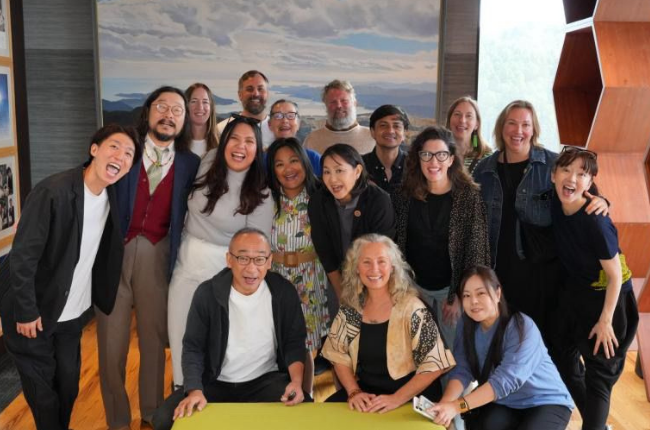
This question sat at the centre of our Regional // Regional program that was embedded in the 2025 SanFes event. Regional // Regional is the flagship program of Asialink Arts and Culture, Australia’s centre for Australian engagement with Asia. Through R // R, Asialink builds a strategic network of Creative Directors and Producers from regional and remote arts festivals and organisations across Australia, Asia, and the Pacific. It is designed to address the cultural and artistic isolation of working in regional contexts. Regional // Regional Sanriku Gathering is the fourth in-person Gathering of the cohort in the last three years, and the first international Gathering. The Sanriku Gathering was attended by 10 Regional // Regional members from Australia, the Philippines, India, Indonesia and Japan. The program was designed and delivered by Asialink Arts and Culture in collaboration with the Sanriku International Arts Festival. The context that Regional // Regional members work in are vastly different, but there is a shared commitment to ethical and responsible cultural exchange, and artist led encounters and programs. The cohort came from across the Asia-Pacific to dance, listen, and exchange practices with Sanriku’s communities, exploring what it means to use art to rebuild post crisis.
Day One in Kamaishi: Memory, Movement, and Resilience
The first official day began with a bus ride through winding mountain roads to Kamaishi. The landscape shifted from dense forest to sudden, glittering coastline. In Unosumai, we met our guide, Aki Kawasaki, who shared her story of surviving the tsunami as a high school student.
We stood where her school once was, now a memorial park and baseball field. “When the earthquake hit, I couldn’t stand,” she said. “I knew a tsunami was coming.” She led us slowly up the steep hill she once ran, dragonflies darting around us in the sunshine. From the top, she described the “wall of black water” that followed, and the overwhelming smell of salt and sewage and the chaos in the evacuation hall. It was almost impossible to reconcile her story with the beauty of the day. This is a place where calm and catastrophe live side by side in the landscape.
That afternoon, we were introduced to the Toramai (the Tiger Dance). The tiger mask was heavy, painted, and surrounded by small bells that chimed as we moved. The movement of the Tiger dance is based on a deep squat, with wide sweeps of the arms. The rhythm, though simple, carried a powerful energy when the movement and the sound of the bells combined. As we practiced, laughter filled the room. It was a physical lesson in adaption, best achieved by surrendering to feeling a bit silly as you learn something new.
That evening, the town hosted the Sanriku Festival opening. We were welcomed by the mayor and treated to a night of Geinoh performances, sake, and shared joy. The atmosphere was warm and generous and watching young children dance with their parents and grandparents was incredibly heartwarming. There was a real sense of connection and pride in being a Geinoh performer. When it was our turn to speak, Regional // Regional member Ruth Langford, a Yorta Yorta, Dja Dja Wurrung woman who lives and works in Lutruwita/Tasmania, sang a song which was a prayer to the grandmothers and to the waters that connect us all. Her voice filled the room, seeking to weave together ancestors, intentions and our homelands.

Later that night, as we rested in our hotel, an earthquake struck. I woke up to the room shaking gently, then an hour later it became more violent. It passed quickly, and nothing seemed damaged, but it left a deep impression. A reminder that the earth here never truly rests, and that the people who call the Sanriku coastline home have learned to live and move with its rhythms.
Day 2 – Continuity and Celebration
The second day unfolded slowly. We were free to explore SanFes performances and encouraged to follow what we found engaging. The air was full of the sound of drums. We watched Taiko drumming groups, elders and children performing side by side, their rhythms echoing through the hall. Taiko, which means "drum" in Japanese, refers to a broad family of Japanese drums and the performative style used when playing them.
We learned the Bon dance from one of the oldest Geinoh troupes in the region. Their movements were fluid, circular, and full of grace. Every gesture carried weight, shaped by decades of repetition and care. It's a simple circular walking pattern, accompanied by soft and floating hand movements. The dance is traditionally performed in the summertime to give thanks to ancestors and pray for a good harvest. As I performed it with the Geinoh troupe, it was easy to imagine the sweep of hand movements echoed harvesting a field or resting a hand on a loved one's shoulder. The repetition allowed you to drop into a moving mediation, where everything felt intentional.
By evening, all the troupes came together in a spontaneous cultural mash-up, Tiger dancers, Deer dancers, drummers, and musicians all blending traditions in a vibrant improvisation. There was so much going on, it was hard to know where to focus but the energy and the spirit was palpable and breathtaking. A young Tiger Dance performer yelled the words of his song into a small megaphone until he was hoarse. It was chaos and beauty in equal measure, a living reminder that culture is never static; it evolves through collaboration, improvisation and a shared respect for each other.
The next morning, mist clung to the mountains around Kamaishi. I walked up into a hillside graveyard and looked down at the town below. I realised that all the hills surrounding the town were lined with graves, each one overlooking the town in the valley below, the dead keeping watch over the living.
Day 3 – Rikuzentakata: A town rebuilt
Driving into Rikuzentakata, the atmosphere shifted. The weight of history was palpable, like stepping into a place that speaks softly of loss. The landscape is flat and full of green space. The town was completely rebuilt from the ground up after the tsunami, including replacing ten metres of soil by carving out the mountains that wrap around the town to fortify its foundations. While everything feels new, it is also clear that the memory of the immensity of what was lost is still present. It clings to the new green space, shiny new buildings and large tsunami wall that is both protection and a barrier to the ocean.
In the afternoon, we visited the local school where our colleague and Regional // Regional member Masoom Parmar from Alif Arts in India led a dance workshop for fifty children. Alif Arts is an arts management organisation representing some of the finest Indian artists from classical dance, folk dance and music and puppetry forms. Masoom’s artistic work explores ideas of identity and belonging through oral, literary and cultural heritage. In minutes, he had them laughing, clapping, spinning together in a circular rhythm. As we left the hall, they called him “the master.” Dancing with them was full of delight, a simple, powerful reminder of how quickly connection can form through movement.
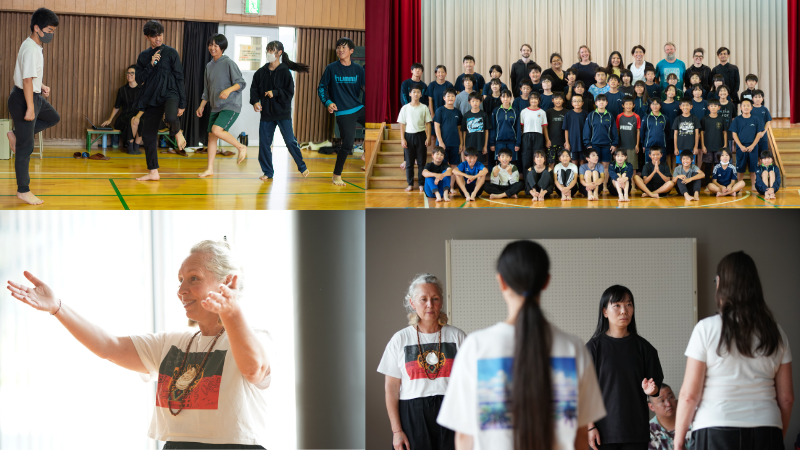
Later that afternoon, Ruth led a meditative movement practice around the theme of water. The workshop included Japanese artists and cultural leaders, highlighted an offering of reciprocity from the Australians. Two lines of people moved slowly toward one another, drawn together as if by invisible currents. The room grew still, full of breath and presence. It was one of those quiet moments where language falls away and what is left is connection.
Day 4 – Looking back, looking forward
Our final day began with a deep dive into the Tazukuri Sword and Fan Dance, led by masters Nobuo Chida and Mikio Yoshida. Through story and movement, we learned of its centuries-old origins and the deep discipline it carries. The dance form is performed at a temple high in the hills only once every few decades, in line with Shinto tradition. Trying on the costumes and stepping into its form gave us an understanding of the balance between beauty and precision.
Later, we gathered for a discussion tracing the ten-year history of SanFes, how it evolved from a post-disaster recovery effort into a community-driven cultural movement. Organisers spoke about how the festival’s strength lies in being led from the ground up, owned by the people who live here. We ended the day in small circles, reflecting on what we had learned. We spoke about the fragility and resilience of place, the necessity of time and care in exchange, and the importance of humility in collaboration.

What we learned, what we shared, and what comes next
What struck me most about Sanriku wasn’t only its history of loss, but the vitality of what has grown in its wake. SanFes is more than a festival, it’s a living expression of community, a celebration of resilience, and a platform for connection.
For Regional // Regional, this exchange reaffirmed why we do what we do. It reminded us that genuine collaboration doesn’t arrive fully formed; it grows over time, through trust and shared experience. It lives in laughter, in missteps, in shared meals and awkward dances. It begins when we show up not as experts, but as guests ready to listen. There were moments of uncertainty and cultural hesitation, but those, too, became powerful teachers, inviting us to slow down, pay attention, and move gently.
Sitting on the tsunami wall in Rikuzentakata, gazing out at the still sea, I felt the depth of what SanFes reveals: resilience is not a single act, it’s a rhythm. It’s in the steady beat of Taiko drums, the careful rebuilding of a town, the laughter of children learning dances older than their grandparents.
We learned that tradition is not the opposite of innovation; it is its foundation. That healing can be danced, sung, and shared. We had the chance to offer our stories, practices, and vulnerabilities. We brought presence, curiosity, and care. And in return, we were welcomed into a community that holds its devastating history with strength and grace.
We learned that place matters. Standing on a tsunami wall, walking through graveyards, or dancing in a sunlit hall can connect you to the rhythm of a place in ways that are both meaningful and lasting. We experienced how an earthquake can shake you into awareness of your own mortality, of impermanence, which is both unsettling and deeply grounding.
The potential for future exchange is immense. SanFes is not just an event; it’s a vibrant space for cultural dialogue. Regional // Regional’s presence here is not a one-off; it’s a seed, a beginning. A planting of new possibilities for exchange between regions, artists, and cultures. This experience has deepened our understanding of what it means to be regional: to be grounded in the rhythm of place and connected through culture. It shows us that both joy and sorrow shape a place and its people, and that this truth is universal. It’s the core of what it means to be human. What matters most is how we use culture and creativity to transmute, to compost, to make sense of it all. To create beauty from pain and renewal from loss.

Regional // Regional is an initiative of Asialink Arts and Culture at the University of Melbourne, supported by Circle 5 Foundation.
The Gathering is designed and delivered with Sanriku International Arts Festival, and assisted by the Australian Government through Creative Australia, its principal arts investment and advisory body. The Gathering also received support from the Yokohama Creative Foundation and Bray's Run Productions.
----------
Photos by: Sanriku International Arts Festival, Sho Ikushima and Yuki Ida
Emma Porteus is a Regional // Regional member, Co-CEO of Assembly197 and Executive Producer at SITUATE. She has over 15 years’ experience working as a performance maker and producer on dance, community and festival projects throughout Australia, South Africa, Finland and Asia. In her current role at Situate, she is really interested in performance and art-making models that connect people and places.
How can we help? Get in touch to discuss how we can help you engage with Asia