Dance, difference and displacement
Can dance foster a more inclusive world? Can the arts open up new approaches to our relations with China?
9 August 2019
By Dr Nicholas Rowe
Our current, farcical refugee resettlement waiting time of 180 years* reveals the world’s collective failure to accommodate the movement of more than 75 million refugees and displaced people. This failure is, however, but a hint of the humanitarian challenge that sits on our horizon.
According to UN estimates, within the next 30 years more than 1 billion people will become displaced and seek refuge, largely as a result of catastrophes emerging from climate change (2). Within Australia this will mean a massive arrival of populations from the East, West and North, and a substantial internal displacement of people.
Our society might react to this huge movement of people (and reduction of hospitable land) in one of two ways. We might continue building fortress Australia, bound tightly together through an ever-narrowing set of cultural denominators to justify our brutal exclusion of others.
Or we might start figuring out how to accommodate a much larger, more diverse and more complex population within a smaller space. To achieve the latter, we need to urgently examine how ideals of inclusion, diversity and social interdependence might permeate all of our pedagogies, practices and policies.
How can such pluralist values actively guide what we teach, what we do, and what we promote?
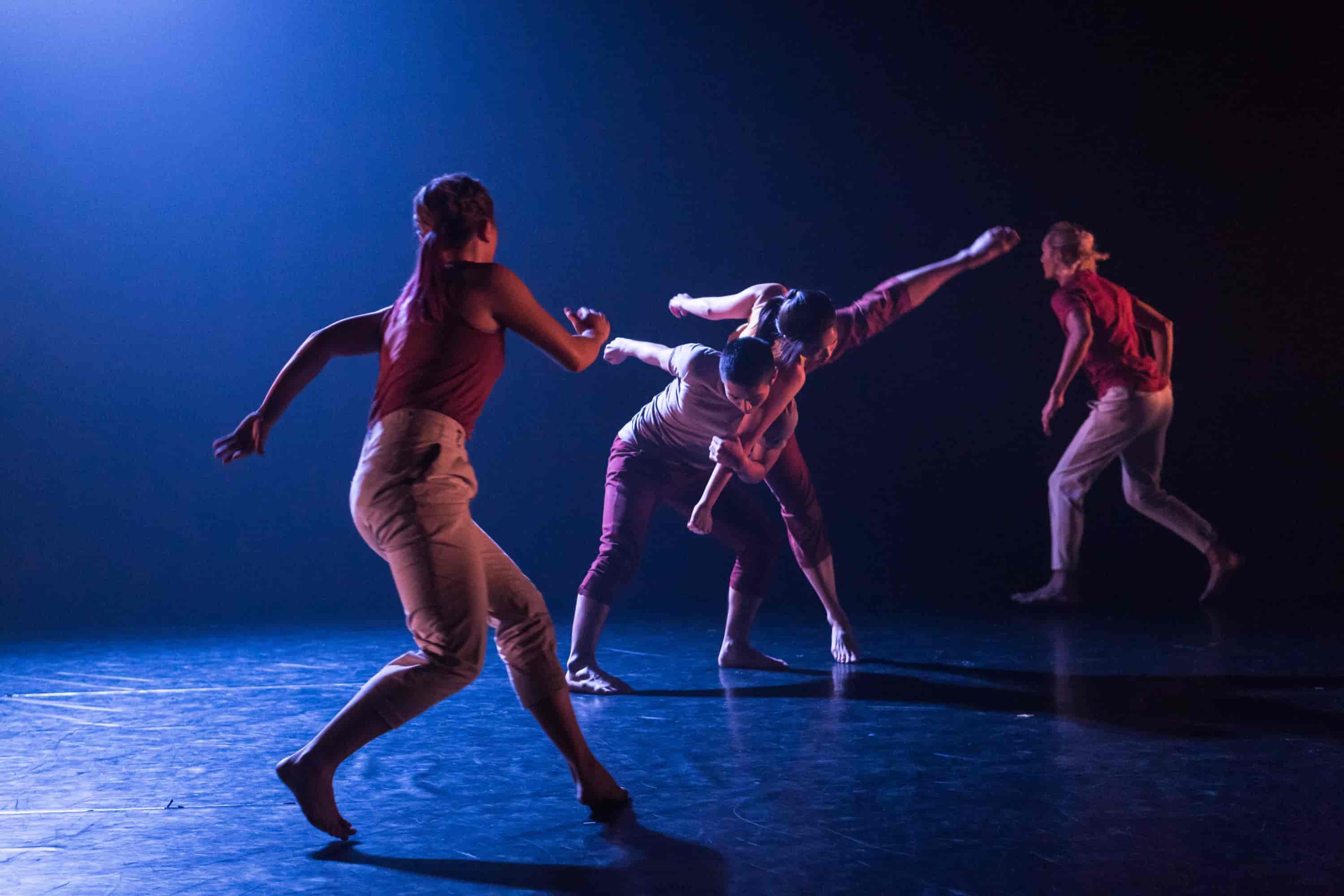
This is a significant issue for dance as a performed art and academic discipline. Similar to architecture and urban design, dance physically embodies our understandings of how we share public and private spaces. Extending upon sociology, dance illustrates how we value human interactions and relationships.
As a culturally constructed phenomenon, the meanings of dance are not universal, but emerge in different ways in different cultures, in response to diverse values and needs. As such, dance allows us to viscerally and visually reveal our different attitudes towards the sharing of space, in ways that transcend the restrictive logic of language.

Dr Rowe with dancers from the College of Chinese and ASEAN Arts at Chengdu University. Image: supplied
Unfortunately, our dominant understandings of dance extend from imperial, modernist and industrial eras that promoted uniformity, cultural hegemony and competition. The standardized, elitist mindset that gave birth to classical and modernist dance forms continues to find popular incarnations in episodes of Dance Moms and So you think you can dance? This has reduced our expectations of where we should dance, when we should dance, what we should dance, why we should dance, and most destructively, who should dance.
At the same time, dance practitioners across Australia are challenging these cultural legacies, and exploring how dance might be expanded as a location for exploring inclusion and diversity.
Groups such as Tracks Dance, Marrageku and Growing Old Disgracefully are pushing the boundaries of what dance can mean within a pluralist society. Their visionary work goes beyond the presentation of inclusion and diversity in a staged dance production; they are actively exploring the ways in which learning, creating and conceptualizing dance might be more responsive to difference. In doing so, they are realizing practices of sharing space that are going to be crucial in the coming decades, if we are to allow pluralism to flourish within a much larger, denser and more complex society.
Curiosity regarding how dance might foster social pluralism is growing across the world. Given the shared nature of our global challenges, there is an imperative that we move beyond nationalist viewpoints when engaging with questions of dance and inclusion.

Within China, I am involved with a strategic research group that is actively seeking culturally diverse perspectives, in association with the Belt and Road initiative. As a gathering of leading academics in dance education from across the world and across China (including the Beijing Dance Academy, Beijing Normal University, Minzu University, Chengdu University, Lanzhou University and Sichuan Normal University), we are exploring how dance pedagogies, practices and policies might be expanded to foster a more pluralistic society. Already our research has revealed how partial translations of previous dance knowledge has created misconceptions between Chinese and Western scholars, confusing academic exchanges.
This has opened pathways for new critical and theoretical questions to emerge that are now challenging the legacies of modernist discourses, constructing new understandings on the nexus of dance, creativity and social cohesion.
This article is adapted from a keynote speech presented by Dr Nicholas Rowe at the Australian National Dance Forum in Darwin on the 9th of August, 2019.
A graduate of the Australian Ballet School, Dr Rowe is an award-winning filmmaker and academic, focusing on dance, collaboration, politics and marginalized people. His books include Raising Dust: A Cultural History of Dance in Palestine, Talking Dance: Contemporary Histories from the South China Sea and Moving Oceans: Celebrating Dance in the South Pacific and feature films The Secret World and Dancing7Cities. He is currently an Associate Professor in Dance Studies at the University of Auckland, an Adjunct Professor at Chengdu University and a Visiting Professor at the University of the Arts Helsinki/CERADA.
* In 2017 according to the Refugee Council of Australia, there were 25.4 million refugees worldwide. In the same year, the number of globally available resettlement places was reduced from 163,000 to 75,000, despite UNHCR assessing 1.2 million refugees were in need of resettlement. The Refugee Council of Australia says that if this global queue did actually exist, people joining the back of the queue might wait more than 180 years for resettlement.
How can we help? Get in touch to discuss how we can help you engage with Asia