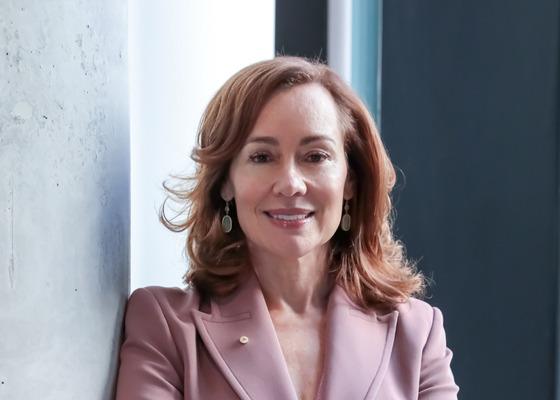
Professor Natalie King OAM (1998 Alumna) - Enterprise Professor of Visual Arts, Victorian College of the Arts, The University of Melbourne
Building Bridges Through Art: A Curator’s Eye for Cultural Diplomacy
In an increasingly turbulent geopolitical environment, curator Natalie King builds bridges not through treaties or trade, but through art. As an internationally renowned arts leader, whose résumé includes curating Australia’s contribution to three Venice Biennales, King has long stood at the intersection of culture and diplomacy.
In an era where the world, as she puts it, “is a mesmerising mess”, cultural diplomacy and connections may be exactly what is needed.
Three decades into her work, Natalie King remains animated not just by the art on display, but by the human stories behind it. “Artists and creatives take you to places you had never imagined,” she says. Reflecting this creative journey, her career, which has taken her from the jungles of Samoa to Timor Leste, Tokyo, and Taiwan, has been anything but conventional.
Her first step toward Asia came in the 1990s with an internship at the inaugural Asia Pacific Triennial in Brisbane. “I got a small amount of funding to intern at Queensland Art Gallery at the close of the first edition in the early 90s,” King recalls. Her motivation then was partly geographical thanks to Australia’s proximity to Asia but driven more by “curiosity and cross-regional relationships”.
Asia in Mind, Art in Hand: Lessons in Leadership
King’s interest in the region matured through the Asialink Leaders Program, where she found herself in Canberra amid a constellation of policy and business leaders. “It was the first time I had met with politicians and people from the military and had an opportunity to understand how people think, how they plan, how they inspire others,” she says. “To this day, I still have relationships with some of the participants. To build those relationships beyond our own sectors was inspiring at that time.”
King has since become a leading proponent of what the diplomatic world refers to as ‘soft power’, which she views as foundational. “Cultural leadership is fundamental to all leadership,” she asserts. “We are all human, and we need to know what inspires us and our communities to find ways to work together and connect. The creative arts are unquestionably fundamental to an inspired community with strong leadership.”
Exhibiting an Architecture of Trust
In the arc of King’s career, art has often been the bridge across language and borders. Her long-standing engagement with Japan, which includes a 25-year collaboration with Tokyo’s prestigious Tokyo Photographic Art Museum (TOP) that has culminated in three exhibitions, is a case in point. “Relationships in Asia are completely essential,” she says with conviction. “Relationships that need to be nurtured, that evolve over time, require effort and consistency.”
However, the Covid-era show Reversible Destiny, held in Japan, most clearly embodied her evolving philosophy. Rather than impose an Australian curatorial framework, King proposed something more collaborative. “Why don’t I meet with your team and understand what is urgent for you in Japan?” she asked her collaborators. The result was a joint curatorial venture that placed Australian and Japanese artists side-by-side, offering not only a bilingual catalogue but also a legacy: “the museum, to their credit, acquired a number of the works for their collection... the first time that Australian artists had entered into this very significant collection in Japan.”
For King, the success of such collaborations lies in the quiet architecture of trust. “A transaction can’t take place unless there is the foundation of a relationship built on trust,” she notes. Asia requires more than a press release and a shipping crate. “One typically wouldn’t reach out to someone without an introduction. The issue of hospitality, welcoming people, cultures and ideas are crucial,” she says.
This approach became vital during the pandemic, when King installed an exhibition in Tokyo entirely over Zoom. “I sat in my living room [in Melbourne] saying, move this piece to the left, move this up,” she says. When the host institution considered cancelling the exhibition, King didn’t flinch. “I had to deploy all my cultural diplomacy skills, sought advice and contacted the Australian Ambassador in Japan to intervene.” The show went ahead. Tenacity, it seems, is another pillar of cultural leadership.
Curating Across Cultures
King recalls missteps early in her career like the time her Japanese-translated business card introduced her as ‘Chief Librarian’ rather than curator. “For the entire trip, everyone’s looking at that, looking at me quizzically and didn’t know why I was there without asking me directly. On the last day, an artist pointed out the misattribution.”
Her vision of Asia capability is, perhaps unsurprisingly, less about formal education and more about a sensibility. “The region is incredibly diverse, and one needs to harness different skills for different situations and different contexts,” she says. “It’s about being adaptive, about listening. Deep listening is very important to the work that I do,” she reflects. “It’s less about me being a curator or an artistic director but the relationships, partnerships, affiliations and comrades that I build along the way. It’s always about reciprocity and collaboration,” says King.
Such adaptability and respect for local contexts has served her well. King’s recent work includes leading a research project focused on wetlands in India that will unfold over time. In response, King advocates moving beyond the fly-in-fly-out model of international curation to embed artists in local contexts. “My investment is always in people and possibilities, especially when resources are constrained.” Prioritising people over logistics means collaborations can drive deeper artistic and cross-cultural exchange.
New Players, New Creative Possibilities
Looking ahead, King sees immense promise in the cultural infrastructure emerging across Asia. New private museums in India and Indonesia are fertile terrain for further engagement. “There’s a fantastic museum in Jakarta called MACAN (Modern and Contemporary Art in Nusantara) that exhibited Australian artist Patricia Piccinini to huge audiences,” she says. Infrastructure may be nascent in some places, but the appetite is there. In addition, the diasporas in Australia are, she argues, an under-tapped audience.
Reflecting on her own journey, King offers advice to her younger self that feels equally relevant to aspiring cultural diplomats today: “Stay curious, stay engaged. I never had a roadmap. So, if I’m working on an exhibition, I’ll try to include artists from Asia, then get funding from Asia, then do a residency somewhere. One step leads to the next.” Her career has been forged not through grand strategy but by “putting one foot in front of the other”, a method that, as it turns out, leads across oceans.
Professor Natalie King OAM is Enterprise Professor of Visual Arts at the Victorian College of the Arts, The University of Melbourne. She participated in the Asialink Leaders Program in 1998.