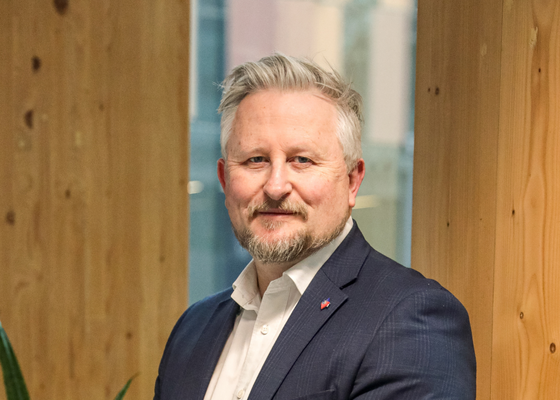
Tom Parker (2004 Alumnus) - National CEO, Australia China Business Council
One plus one equals three: A business card for Beijing
When the Australia-China relationship re-emerged from the diplomatic deep freeze in recent years, few were better placed to capitalise on the thaw than Tom Parker. Soon after being appointed national CEO of the Australia China Business Council (ACBC) in late 2023, Parker watched as Prime Minister Anthony Albanese met with Xi Jinping in Beijing, an encounter that signalled the easing of tariffs and the cautious return of engagement after a couple of years of tension.
“That’s when the green lights and the boom gates started lifting,” he recalls. “We really enjoyed playing a role, particularly with lobster, and to a lesser extent with wine, in getting those industries back.”
Parker has observed the ebb and flow of the bilateral relationship, along with the public sentiment that accompanies it, noting periods of ‘unrealistic optimism’ as well as phases marked by a disproportionate focus on risk. For Parker, a seasoned operator in the business of bilateral engagement, this was less a new chapter than a return to form. “ACBC is an independent, membership-based organisation that helps Australian businesses better understand and engage with China,” he explains. Increasingly, it also supports Chinese businesses looking to invest into Australia.
Yum cha, red packets and a head start
His own relationship with China began well before recent geopolitical ructions. “I benefited from having Asia engagement embedded at a young age,” he says. Parker’s sister married into the Melbourne Chinese community in the 1980s, introducing him to yum cha and red packets, known as ‘Hong Bao’ as a child.
Learning Chinese at school back then was unusual, but unlike many of his peers, Parker had a cultural map before he learned the language. “I had a context within which to place that learning, and it made sense.” That grounding fed his professional sensibility. “It’s had a huge effect,” he reflects, “it’s part of my personal and professional identity in many respects.” Parker went on to study Chinese at the University of Melbourne, the Australian National University and in China before teaching at Canberra Grammar.
A business card for Beijing
His early career hopscotched across sectors in Australia and China. He moved from Red Gate Gallery to Austrade and then the ABC before returning to the City of Melbourne as a media adviser to Lord Mayor John So. “Because I spoke Chinese, I was able to move into the international relations and trade team and found myself in a really happy space there.”
In 2004, as part of the Asialink Leaders Program, Parker created the China in-country professional development program. After initially incubating the program at the City of Melbourne, he saw an opportunity to convert it into a China advisory business: Red Tape Consulting. The Asialink Leaders Program helped Parker to find his niche, “helping Australian businesses to understand and to engage with China… through trade missions, through consultancy, through research,” he says.
From there, Red Tape was acquired and Parker pivoted again, this time to Chinese-language marketing. “It was before Xiaohongshu, often referred to as ‘Chinese Instagram’, and all the others, we were doing WeChat, Weibo... really catering to the inbound Chinese market into Australia, doing work for Australian brands,” looking to reach international students and tourists.
Footy diplomacy in the People’s Republic
And then came footy. “Weirdly, I got introduced to the Melbourne Football Club,” Parker says. A plan to play an exhibition game in Tianjin ballooned into a logistical odyssey. “We ended up taking 200 people including supporters, members, corporates, the players, the staff… We did a race around Beijing,” he recalls. “That was quite crazy.” The game, part of the 2010 World Expo in Shanghai, became a landmark in sports diplomacy and the unlikely genesis of a Chinese sponsor for the Club.
In addition, Parker secured China Southern Airlines as the sport’s first sponsor from mainland China. “Three quarters of our meetings were always spent trying to explain what Aussie Rules football is,” he admits. But the sponsorship stuck and so did Parker’s interest in merging commercial ambition with cultural understanding. He continued working in the sport and gained “the wonderful title of Head of China for the AFL,” charged with broadcasting, commercialising and embedding the code in China. “That was a really interesting and exciting job,” he says.
Diaspora not as a resource, but as a partner
Yet barriers persist in Australia’s engagement with China, says Parker. “There’s still a lack of representation. There’s still questioning of belonging.” He recalls a senator querying Chinese Australians about their loyalty just a few years ago. “There needs to be a spotlight and a championing of the relationship.”
He is wary of rhetoric that commodifies the diaspora. “We often hear that the Chinese Australian diaspora is a resource. I would argue that they’re to be engaged, not leveraged.” He sees promise in cities like Melbourne and Brisbane, where diaspora communities “added a different dynamic, and I think we’re richer for it.” Parker encourages local communities to make space, mentor and share opportunities and access to diaspora groups. “It requires more than being sympathetic,” he suggests. “It is about being consistent, accountable and ensuring inclusion is embedded in systems and processes.”
His mantra, forged over years of crossing borders both literal and cultural, is disarmingly simple. “One plus one equals three,” he says. “That’s my approach to engagement.” He explains: sometimes the principle of ‘When in Rome’ applies, but there are cases where bringing something from each other’s culture, “if you can bring kind of a cultural synergy, you can create something new, which is actually much more powerful, whether that’s a new way of delivering a project, or a new performance.”
Bridging the divide culturally, commercially, politically
What excites him now is the scale of possibility. “The region is going to continue to grow,” he says. Parker points to the Regional Comprehensive Economic Partnership (RCEP), which covers “30% of the world’s GDP.” China’s middle class is projected to grow to 800 million people in the next decade. The country is making rapid progress in decarbonising its economy and adopting renewable energy. “We’re not going to reach our net zero targets without collaboration or partnership with China,” particularly in areas like renewable energy, he says.
In the current climate, where divisions between great powers over technology and supply chains are widening, Parker believes Australia could play a different role. “I believe Australia can serve as a bridge between divergent systems, values, and ideas,” says Parker. “That’s how I see myself and how I see the work of the ACBC. We need more people and more organisations to be able to do that.”
Tom Parker is National CEO of the Australia China Business Council. He completed the Asialink Leaders Program in 2004.