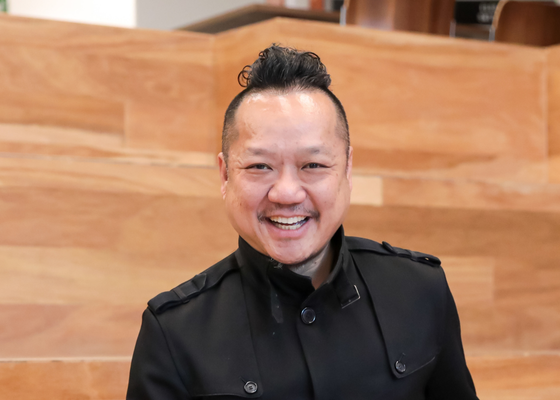
Gary Lee OAM (2010 Alumnus) - Manager of International Education, City of Melbourne
Exporting education, importing influence: The long tail of the diaspora
Malaysian-born Gary Lee arrived in Melbourne against his will. He had lost a “heated negotiation” with his mother, who insisted he follow in his siblings’ footsteps by studying in Australia. He planned to graduate quickly, make some friends with “blue eyes and blonde hair,” and head home with an Aussie accent. None of that happened. Instead, he built a life in Melbourne and helped to shape the city.
More than twenty years later, as the City of Melbourne’s Manager of International Education and a proud recipient of the Medal of the Order of Australia, Lee is one of the architects of Melbourne’s transformation into an “Asian city,” one driven by the often-overlooked soft power of international students and diaspora communities.
Within three days of arriving in Australia, Lee was volunteering with RMIT’s Association of International Students. “They laughed, because I was so overenthusiastic,” he says. But that earnestness became a defining feature. “That seems to be my catalyst for where I am now,” says Lee.
A city reimagined
Melbourne has changed since Lee’s student days, and in no small part due to his work. “When I was at RMIT, we were looking after 6,000 international students,” he recalls. “Now in Melbourne, we have 258,000 international students in Victoria. It’s massive.”
The demographic shift has redrawn the city’s cultural and economic landscape. “More than about a third of the City of Melbourne local government area’s population are international students,” he estimates. “And 55% of our population are born overseas, and 70% have at least one parent born overseas.”
That shift didn’t happen by accident. “Back then, Lord Mayor John So envisioned the city to be an Asian city and a university city,” Lee explains. It was under this remit that the council created Lee’s role, a move that would become a national first. “We’re still the only council in Australia that has a designated team just for international students,” he says.
Walk through the city now, and the signs are everywhere. “Bubble tea shops every second shop,” Lee quips. “We have the best Thai. We have the best Chinese restaurants.” But, beneath the dumplings and taro pearls lies an economic and strategic engine.
Learning to lead, from within
In 2010, Lee joined the Asialink Leaders Program, an experience he calls “life-changing and quite career-changing.” Though Malaysian-born, Lee says the course helped him rediscover what he could offer. “When you’re away from the country, you feel how little you may know about your own country… but learning about Asia, being an Asian, and viewing it as a strength. I found that quite refreshing.”
At the time, international education was still a niche sector. “Most of the participants were from a different industry,” he remembers, with the focus of discussions being on “manufacturing, trade and investment.” Since then, Lee’s colleagues who have also participated in the Program have noted that international education is a bigger part of the discussion, reflecting its growing role in the national economy.
For Lee, the Program helped him realise that Australia didn’t need to look far to understand Asia. “We have many international students in Melbourne. We have a strong diaspora community here, but we don’t necessarily tap into that potential.” That insight has since become a mantra. “We’re very good at going overseas to get that knowledge,” he says, “but not tapping it within Australia itself.”
Beyond bubble tea: The strategic depth of diaspora
What began as a personal realisation soon evolved into a broader thesis: that Australia’s best insight into Asia might already be living in its own suburbs. “Whether they stay or go home, international students are ambassadors,” Lee insists. “They recommend that people study here. Their families come for graduation. They come back for holidays. International students strongly support the visitor economy.”
But whether international students see themselves as part of the diaspora is still up for debate. “The sense of belonging is challenging,” Lee concedes. “Most students still crave that connection with locals.” However, he also sees value in connecting with diaspora communities from the outset. “Traditionally, that’s not the favoured approach because some think, ‘why come all the way to Australia just to mix with Malaysians?’ But if they connect with the Australian-Malaysian community, the aunties and uncles, not just student groups, it gives them a head start and helps to foster a sense of community, familiarity and belonging while navigating a new culture.”
More importantly, Lee argues, international students, who were once dismissed as a transient population, are now “a huge part of the economy” in ways that go beyond tuition fees and part-time jobs. “We’re now looking at them as talent,” he says, “they are business owners, entrepreneurs, volunteers, employers and employees.”
“We know that international students, a lot of them, then become diaspora communities and live here in Australia,” he says. These former students are knowledge brokers, bridging professional, cultural and commercial gaps between Australia and Asia.
Yet international students are too often an underutilised asset, Lee notes. In his eyes, Australia must shift its mindset. “We cannot afford not to tap into that knowledge. We need to push it beyond fashion, food and festivals,” he urges. “There’s more to it. The nuances are stronger. It’s about how we work with Asians and understand how Asians think.”
Living in the third space
Lee himself exists in what he calls “the third space”, the hybrid cultural zone navigated by many migrants. “I may be Malaysian, but I’m also Chinese, and I’ve lived in Australia most of my adult life. You can’t just look at me and go, ‘He’s Malaysian; he does things a certain way.’”
This concept of dual (or triple) cultural fluency is increasingly vital, he argues, in both diplomacy and business. “Emotional intelligence is more important than cultural communication workshops,” he says. “The more you understand of cultures, the easier it is to adapt.”
Boosting the campus-to-career pipeline for international students
And if Lee could wave a magic wand? “I want businesses, employers and organisations to look at international students the way they look at talent,” he says firmly. “They’re a highly resilient group. They come with networks. They come with knowledge. We want them to have a fair go.”
The challenge, as Lee sees it, is not a lack of willingness from students but a lack of vision from employers. “We’re good at welcoming students to study here, but then we waste the opportunity by not engaging them in the workforce.”
It is, he warns, a risk Australia can no longer afford. “I’m trying to change the narrative from ‘Why are you not employing international students?’ to ‘You cannot afford not to.’”
Gary Lee OAM is the City of Melbourne’s Manager of International Education. He completed the Asialink Leaders Program in 2010.