The prospects and limits of US-North Korea diplomacy
Donald Trump probably would like to re-engage North Korea’s Kim Jong Un in talks. But writes Andrei Lankov, if Trump succeeds in drawing Kim back to the negotiating table, he will have to accept tougher concessions than in the past, including tacit acceptance that North Korea will not give up its nuclear weapons.
25 January 2026
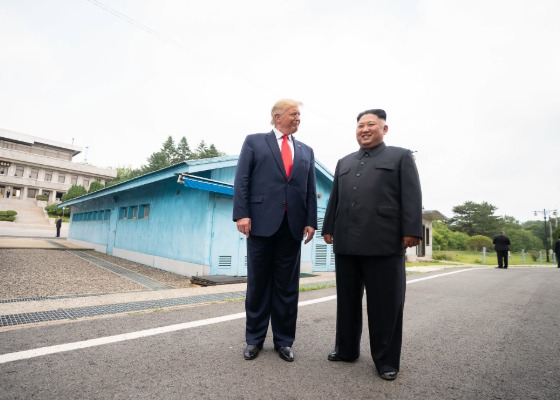
Do you remember 2018, when the world’s media could not stop talking about a “Korean Peninsula spring” and about the US-DPRK-ROK negotiations that, we were told, would soon “solve” the North Korean nuclear issue? After a couple of tense years, when even a new war on the peninsula briefly seemed possible, the leaders of the United States, North Korea, and South Korea engaged in a series of summit meetings which lasted for about a year.
However, this flurry of diplomatic activity, which had the officially declared goal of CVID—the “complete, verifiable, and irreversible denuclearization” of Korea—ended in nothing. This failure should not surprise us. As this author never tires of repeating, the North Korean leadership has never had the slightest intention of surrendering its nuclear weapons. Pyongyang sees its nuclear arsenal as the only reliable guarantee of security and long-term survival, and, occasionally, as a useful tool of diplomatic blackmail.
Thus, the heavily publicized 2018–2019 talks ended in failure, and the Joe Biden administration showed little interest in reviving them.
Now, however, Donald Trump is again in power in Washington. Is it likely that he will once again engage in talks with North Korea? Well, over the past year there have been numerous hints from both sides suggesting that both Washington and Pyongyang would not mind resuming dialogue. But what should we realistically expect if such talks actually begin?
First, North Korea’s nuclear disarmament is not going to be the true goal of any negotiations. This objective has long ceased to be, if it ever was, realistic. North Korea is a nuclear state and will remain one for the foreseeable future. Having seen what happened to Libya, Iraq, and Ukraine, it is difficult to blame Pyongyang for its stubborn unwillingness to give up its nuclear weapons. North Korean leaders never tire of repeating that foreigners should not expect denuclearisation.
Most likely, if talks begin, they will follow the path partially explored during the last meaningful US–DPRK summit, held in Hanoi in February 2019. At that time, the sides discussed a deal under which North Korea would dismantle all nuclear facilities at the Yongbyon Nuclear Research Complex in exchange for lifting sectoral sanctions imposed by the UN Security Council. These sanctions created serious obstacles to North Korea’s economic development by making nearly all forms of legal international trade impossible.
Such a deal would make a certain amount of sense. For the United States, it would significantly slow North Korea’s nuclear program. No doubt, even if deprived of its major facilities, North Korean scientists and engineers would continue their work, clandestinely, if necessary, but the pace of their progress would decline dramatically. If a Hanoi type deal is reached, North Korea would remain a nuclear state, yet its ability to produce additional warheads and develop more advanced weapons would be severely constrained.
For North Korea, such a deal would also bring tangible benefits. It would allow the country to resume trade with a wide range of states. At present, North Korea can trade only with a handful of countries willing to ignore UN Security Council decisions, such as Russia and, to some extent, China. Easing sanctions would also reduce North Korea’s dependence on China, a dependence widely resented by the North Korean leadership.
However, there is a problem. In 2019, at the Hanoi summit, North Korea was in a far weaker position. Pyongyang was heavily isolated and faced something close to a united front involving the United States, Russia, and China. North Korean diplomats felt cornered, and the country’s economic situation was dire.
Today, the situation is very different. Both Russia and China are now willing to provide North Korea with substantial assistance. Trade with these two patrons has allowed North Korea to improve its domestic economic conditions.
A “Hanoi-style” deal might still be attractive to Pyongyang, but far less so than it was five or six years ago. This means that North Korea is now likely to take a much tougher negotiating position. It will demand more concessions from the United States while being willing to offer less in return. This could become a serious obstacle.
In 2019, Donald Trump walked away from the Hanoi talks precisely because he believed that North Korea was asking for too much while offering too little. This time, any new agreement, if it is reached at all, would almost certainly be negotiated on terms significantly worse for the United States than those Trump himself rejected in Hanoi, and rejected quite dramatically. Whether a US president who dislikes being perceived as weak would be willing to accept such a revised deal remains an open question.
What is clear is that North Korea is no longer in a hurry. Pyongyang may be interested in talks, but it is under no real pressure to engage. Thanks to changes in the global environment, North Korea now has more resources and external support than at any point since the late 1980s. Consequently, it can afford to wait.
A new round of US–DPRK negotiations remains possible, and there is even some chance that such talks could succeed. But it is essential to understand that this time the United States would have to make far more substantial concessions than it would have needed to make in the past. Is President Trump ready for that? Nobody knows.
Andrei Lankov is Professor of Korean Studies at Kookmin University, Seoul, and Director of NK News.
How can we help? Get in touch to discuss how we can help you engage with Asia