Why Bhumjaithai won
Prime Minister Anutin Charnvirakul enjoyed the power of incumbency in Thailand’s elections. And Mathis Lohatepanont argues he used that advantage wisely—combining appeals to populism, nationalism and traditional establishment values.
16 February 2026
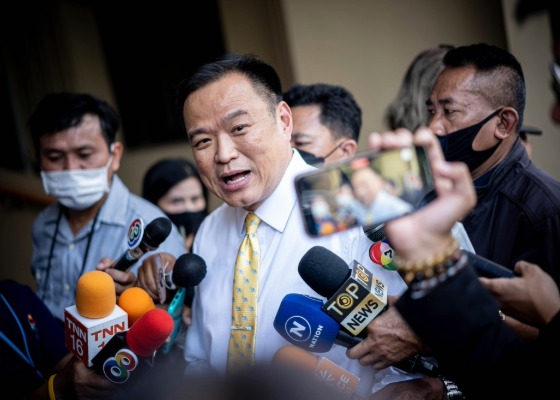
Before 2025, the Bhumjaithai Party was little-known outside of Thailand. A mid-sized party that had its roots in a renegade faction that broke away from former prime minister Thaksin Shinawatra, Bhumjaithai has never able to lead a government. A campaign promise in 2019 to pursue the legalisation of marijuana for medical purposes created headlines, but otherwise the party was largely just a curiosity to international observers.
Not anymore. The February 8 general election delivered Bhumjaithai a clear victory, giving it a projected 193 seats. This guarantees that its leader, Anutin Charnvirakul, will continue serving as prime minister. The People’s Party, whose predecessor Move Forward won in 2023, was relegated to a distant second place at 114 seats.
It is worth noting that allegations of electoral irregularities have emerged since the election. This includes an implausibly large gap between the number of party-list and constituency ballots cast in several constituencies. However, the Bhumjaithai margin of victory was sizable enough that even if recounts in several constituencies were to go against the party, it would still be the election-winner. So what explains this result?
Bhumjaithai’s emergence was, ironically, facilitated by the People’s Party. After the fall of the Pheu Thai government of Thaksin’s daughter Paetongtarn in 2025, the People’s Party and Bhumjaithai signed a confidence and supply agreement, which enabled Anutin to govern on the condition he dissolved parliament within four months and agreed to begin the process of constitutional reform. Anutin became prime minister, despite Bhumjaithai being merely the third-largest party in parliament, handing him all the advantages of incumbency.
Anutin used these advantages wisely. Upon entering government, he reshuffled several senior officials within the Ministry of Interior. As Mahidol University Professor Punchada Sirivunabood noted, this allowed Bhumjaithai to “exert greater influence over provincial administration,” which was key in “facilitating voter mobilization and strengthening the Bhumjaithai’s position in key constituencies.”
He appointed several technocrats to lead important ministries, including Commerce Minister Supajee Suthamphun, who became highly popular with the public. Anutin campaigned heavily on a pledge to retain these technocrats if he were elected to a full term. For voters previously sceptical about Bhumjaithai’s governing credentials, given that the party was previously composed largely of local grandees, this persuaded many voters to give the party a chance.
With a clear expiration date on the government, Anutin pushed to immediately launch popular policies that would increase the government’s popularity. He revived the Khon la khrueng (“Let’s go halves”) program, first pioneered by former prime minister Prayut Chan-o-cha during the COVID pandemic, under which eligible consumers have half the cost of purchases of certain household items from registered SMEs subsidised by the government up to a daily limit. Anutin pledged that this popular program would continue if he were returned as prime minister.
Renewed fighting at the Cambodian border also led to rallying around the flag, with Bhumjaithai as the main beneficiary of the increased nationalist sentiment. Where the People’s Party struggled with questions about its past rhetoric questioning the role of the military, Anutin was able to deliver a full-fledged nationalist pitch to voters, arguing that he was the choice that Cambodia would fear the most. This likely motivated more nationalist voters to turn out to vote.
Becoming prime minister allowed Anutin to emerge as the main conservative contender, after other conservative parties had been weakened over the years. Anutin, who has steadily branded Bhumjaithai as a party strongly committed to defending the monarchy, was able to consolidate the support of the conservative electorate.
And most importantly, Anutin was able to convince several incumbent MPs from other parties to join Bhumjaithai. Over sixty incumbents would end up defecting to the party, significantly increasing its strength in local constituencies around the country. The deeply entrenched local networks that these MPs brought ensured that even though the People’s Party triumphed on the national party-list ballot, which is used to elect a hundred MPs, Bhumjaithai would emerge well ahead in the total number of constituencies, of which there are four hundred.
That local networks prevailed over the national sentiment is also visible from how Kla Tham, a Bhumjaithai coalition partner, was able to win almost sixty constituencies despite winning very few votes on the party-list ballot.
Neither the People’s Party nor the Pheu Thai Party were able to withstand these advantages. The People’s Party decision to support Anutin proved immensely controversial and likely had a heavy impact on its popularity. Its current set of leaders proved unable to match the charisma of Pita Limjaroenrat, the leader of the People’s Party predecessor, the Move Forward Party. Pheu Thai, on the other hand, was still reeling from the fallout of former prime minister Paetongtarn Shinawatra’s phone call with Cambodia’s Hun Sen. Turnout was ten percent lower than in 2023, demonstrating that many voters could not be convinced to show up for parties they felt lukewarm about.
The next coalition government is likely to be an alliance between Bhumjaithai, Pheu Thai, and Kla Tham. The large size of Pheu Thai and Kla Tham may make the coalition vulnerable to infighting, however. One particular challenge may be the negotiation of cabinet seats, as Anutin has promised multiple posts to his popular technocrats, which will come at the expense of other members of the coalition. Disagreements between Bhumjaithai and Pheu Thai may also emerge over the drafting of a new constitution, which was approved by voters in a separate referendum.
Bhumjaithai’s victory marks the first time in decades that a pro-establishment political party in Thailand has emerged from an election with the most seats. Thailand’s conservatives now have a blueprint on how to win an election, and the aura of electoral invincibility that surrounded the anti-establishment parties has been decisively punctured.
Mathis Lohatepanont is a doctoral candidate in the Department of Political Science at the University of Michigan.
How can we help? Get in touch to discuss how we can help you engage with Asia