A third way for Indonesian foreign policy
President Prabowo Subianto’s highly personalised foreign policy risks making Indonesia not a peer, but a pawn of the great powers. Alexander R. Arifianto and Klaus Heinrich Raditio argue a better approach is to diversify relationships to create a third path with fellow middle powers.
17 March 2026
A third way for Indonesian foreign policy
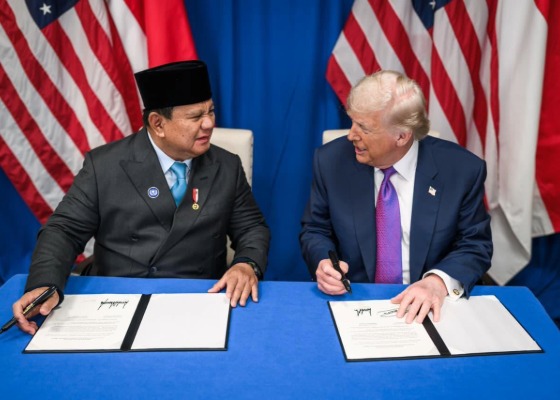
On 19 February, US President Donald Trump and Indonesian President Prabowo Subianto met in Washington to sign the “Implementation of the Agreement Toward a New Golden Age for the US-Indonesian Alliance.” The term “alliance” sits uneasily with Indonesia’s law on foreign relations, which mandates a non-aligned foreign policy. Moreover, the Agreement on Reciprocal Trade—the core of the deal—appears unbalanced and has sparked controversy over three key issues.
First, the agreement is detrimental to a developing middle power nation like Indonesia. The mandatory purchasing requirements imposed by the Trump administration undermine the growth of Indonesia’s agriculture and energy sectors. It is unfair for Indonesia to be required to purchase agricultural commodities such as cotton, rice, soybeans, and corn—products that are crucial for its food resilience. Furthermore, Indonesia’s early-stage renewable energy development is threatened by the obligation to buy US fossil fuel commodities valued at $15 billion.
Second, the agreement requires Indonesia to “adopt a measure with an equivalent restrictive effect as the measure adopted by the US towards third countries that could harm US economic or national security, as stated in Article 5.1. This clause seriously undermines Indonesia’s “free and active” foreign policy principle and, according to some interpretations, effectively makes it a US ally.
Third, Prabowo’s diplomacy has come under scrutiny, particularly following Indonesia’s agreement to join the controversial Board of Peace (BoP). Indonesia’s BoP membership has fuelled domestic criticism of the government. Indonesian academics, Muslim clerics and the broader public have questioned both the effectiveness of the BoP in addressing the Gaza crisis and Prabowo’s decision to join it.
Had Indonesia obtained more favourable trade concessions as part of the arrangement, public reservations might have been less pronounced. However, the fact that Indonesia’s decision to join the Board of Peace did not translate into improved trade terms has intensified doubts about the country’s diplomatic leverage with the United States – particularly after Indonesia invested so much diplomatic effort to please Trump since the initial tariff announcement was made in April 2025.
In short, the US–Indonesia Agreement for Reciprocal Trade is an asymmetric agreement that imposes numerous obligations for Indonesia to purchase various US goods and services, while generating very few benefits for Indonesian products, apart from a small number of agriculture and textile products, which are granted a zero tariff. This raises broader questions regarding Indonesia’s foreign policy strategy.
Prabowo’s leader-centric foreign policy
Under Prabowo’s leadership, foreign policy is increasingly personalised – driven by his preference to meet directly with other world leaders - , in contrast to the institutionalised approach of the President’s predecessors, who allowed the Indonesian Foreign Ministry (KEMLU) to fully engage in foreign policy making.
Foreign policy under Prabowo has been defined by demonstrations of authority at home and the establishment of strongman-to-strongman ties abroad. Prabowo appears drawn to centralised models of leadership, such as Xi Jinping’s consolidation of power and Donald Trump’s loyalty-based politics. Prabowo’s leader-centric approach to accommodate Trump, has mirrored his approach to Xi — as evident in the controversial joint statement issued during a November 2024 visit to Beijing. For Prabowo, cultivating personal relations with world leaders appears to come first; strategic gains are expected to follow.
The strategy of engaging with major powers based on personal relationships is inherently limited. It risks portraying Indonesia as unprincipled, willing to make concessions merely to gain favour with superpower leaders. This can backfire domestically, as it often relates to controversial issues like maritime rights and economic sovereignty. Moreover, leader-centric approaches to foreign relations are unsustainable; Trump will not be eligible for re-election after 2028, and there are also indications that Xi Jinping may cede some of his power.
Nonetheless, Prabowo’s diplomacy should be seen in the context of a deterioration in the post-Cold War international order. The rise of China is a significant factor in this decline, but Trump's handling of China has accelerated the collapse of the existing order. We are entering a phase of intensifying great power rivalry. Prabowo’s engagement with the leaders of both great powers demonstrates his awareness of this reality. He aims to adapt to the new circumstances, while aspiring for Indonesia to be part of the change. Prabowo accurately identifies the collapse of the post-Cold War order, but his response may not be adequate.
Strengthening cooperation with emerging middle powers
Emerging economies like Indonesia should not simply negotiate with major powers, as doing so places them in a position of weakness. Instead, Indonesia should seek to diversify its relationships to create a third path alongside fellow middle powers. While remaining pragmatic, Indonesia must also be principled in defending its sovereignty and interests. The EU has demonstrated the viability of this approach, maintaining security ties with Washington while simultaneously engaging with China on its own terms.
Indonesia needs to adopt a similar approach: Strengthen its domestic economy and cooperate closely with other countries that share a commitment to resist coercion from major powers. One practical avenue would be to renew its intention to join the Comprehensive and Progressive Agreement for Trans-Pacific Partnership (CPTPP). In the wake of President Trump’s so-called “Liberation Day” tariff, the European Union (EU) and CPTPP members formed a closer trade alignment last November, reflecting an effort to create what Canadian Prime Minister Mark Carney described at the 2026 World Economic Forum as a “third path with impact.” Together, this bloc represents roughly 32 percent of global GDP and 37 percent of global trade, underpinned by a strong commitment to open, rules-based trade.
Similarly, other regional economic initiatives such as the Regional Comprehensive Economic Partnership (RCEP) can deliver tangible benefits—provided Indonesia is serious about leveraging its provisions. Research from the East Asian Bureau of Economic Research and CSIS Jakarta has shown that a strengthened RCEP, which includes ASEAN, Australia, China, Japan, New Zealand, and South Korea, could boost ASEAN’s economic growth by 1.9% and employment by 2.1%. The key is not necessarily to formulate a completely new strategy but to adapt existing institutions to better align with the current reality.
Indonesia should not rely on personal ties with great powers but engage with them in a principled and pragmatic manner. By banding together with other middle powers on this new “third path,” Indonesia can build multilateral cooperation with other emerging middle powers to withstand major power pressures.
Alexander R. Arifianto is Senior Fellow and Coordinator (Head) of the Indonesia Programme at the Institute of Defence and Strategic Studies (IDSS), S. Rajaratnam School of International Studies (RSIS).
Klaus Heinrich Raditio is a lecturer in Chinese Politics at the Driyarkara School of Philosophy, Jakarta.
How can we help? Get in touch to discuss how we can help you engage with Asia