The promise of a middle-power alliance
In his landmark Davos speech, Canadian Prime Minister Mark Carney urged the world’s middle powers to band together, or else risk being dominated by the United States and China. But write Moreno Bertoldi and Marco Buti, they must strengthen trade ties, develop autonomous supply chains, and implement meaningful institutional reforms to succeed.
2 February 2026
Amid escalating geopolitical tensions, the world is increasingly caught between the United States – an extractive superpower – and China, a “dependency superpower” whose global influence rests on making other countries reliant on its exports. In the absence of meaningful resistance, both are likely to remain on their course, with middle powers forced to comply with their demands or face retaliation.
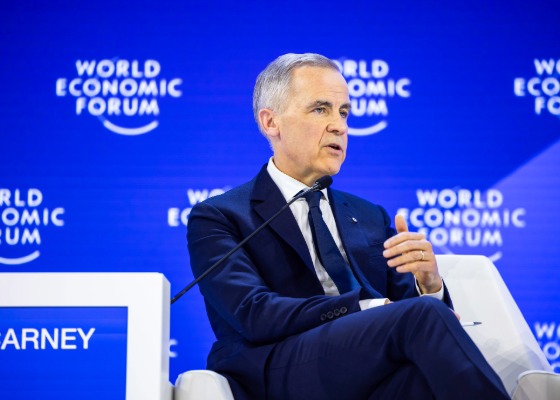
But as Canadian Prime Minister Mark Carney argued in his landmark speech at the World Economic Forum’s annual gathering in Davos in January, this outcome is not inevitable, especially if middle powers band together. In a “world of great power rivalry,” he noted, “the countries in between have a choice: compete with each other for favour or to combine to create a third path with impact.”
The question is how to construct this third path. Doing so will require identifying concrete areas for cooperation among middle powers, building alliances capable of delivering results, and agreeing on institutional and policy changes – particularly within the European Union – that would make collective action more effective.
Five key priorities stand out, some of which Carney highlighted in his speech. First, middle powers should develop a new network of free-trade agreements, like the one just reached between the EU and India. Political and economic ties could be strengthened by expanding existing agreements, deepening cooperation between large trade blocs – most notably, the EU and the Comprehensive and Progressive Agreement for Trans-Pacific Partnership – and establishing comprehensive strategic partnerships like the one between the EU and Canada.
Second, supply-chain diversification must become a top priority. As the US turns to protectionism in order to reshore production and redirect investment flows away from its allies, middle powers have a shared interest in building more autonomous supply chains, including in sectors currently dominated by the US and China, such as digital infrastructure and AI. Over time, these supply chains should increasingly rely on domestic demand, reducing dependence on Chinese inputs and US markets.
Third, rebuilding the multilateral order should begin with reforming the World Trade Organisation. Ahead of the WTO’s upcoming ministerial conference in Cameroon, EU member states – in coordination with other middle powers – should convene an international conference aimed at shaping a post-US agenda and present a shared proposal for ensuring free and fair trade.
Fourth, the legitimacy of any coalition of middle powers depends on its ability to support the world’s most vulnerable economies. The EU should lead international efforts to close the $60 billion funding gap created by the dismantling of the US Agency for International Development (USAID) under President Donald Trump. Team Europe – a humanitarian and development-aid initiative bringing together EU institutions and member states – could begin by reallocating a portion of its roughly €90 billion ($107 billion) budget while urging countries like Canada, Japan, and Australia to follow suit.
Lastly, the global climate agenda must be re-energised. With the Trump administration openly denying climate change and waging a campaign against clean energy, middle powers have a responsibility to lead the green transition.
Given that a middle-power alliance would seek to constrain the US and China rather than confront them directly, it could remain flexible and adopt a pragmatic “variable geometry” approach. As Carney put it, such an arrangement would rest on “different coalitions for different issues, based on common values and interests.” Accordingly, the group of middle powers addressing geopolitical pressures need not be identical to the one focused on diversifying and strengthening supply chains.
That flexibility, however, cannot come at the expense of coherence and solidarity, especially when one member is unfairly targeted by a superpower. When the Trump administration hit Brazil with 50% tariffs in response to the trial of former President Jair Bolsonaro for his 2023 coup attempt, most US allies remained silent, underscoring the need for unity as a defence against blatant economic coercion.
A united middle-power alliance would have considerable leverage, as its members would each wield outsize influence over specific domains. The EU, for example, is an economic powerhouse; India and Japan are the world’s fourth- and fifth-largest economies, respectively; Canada is an energy superpower; Brazil and Australia have vast natural resources; and the United Kingdom remains a major financial hub. On their own, these countries punch well below their collective weight; together, they could rival the influence of the US and China.
But to be effective in a future middle-power alliance and address the “rupture” in the liberal international order highlighted by Carney, middle powers must reconsider their “business model.”
The EU, as we have previously argued, remains an “incomplete” superpower. Its history, nature, and institutional architecture prevent it from becoming a full-fledged superpower. But it can still leverage its strengths.
At current prices, the EU’s GDP and military spending exceed China’s, while its soft power – measured by development aid – surpasses that of both China and the US. To become a “less incomplete” superpower and assume a leadership role in the middle-power alliance, the EU must undertake far-reaching institutional reforms, such as abandoning its unanimity requirement, removing the remaining barriers to a fully functioning single market, and issuing a common safe asset. Above all, it must establish a genuine defence union.
As Carney pointed out at Davos, the old international order is “not coming back.” But if middle powers get their act together, today’s fractures could create the conditions for a new order in which liberal values and institutions can thrive.
Moreno Bertoldi is Senior Associate Research Fellow at the Italian Institute for International Political Studies (ISPI). Marco Buti is Tommaso Padoa-Schioppa Chair at the European University Institute’s Robert Schuman Center and an external fellow at Bruegel.
Copyright: Project Syndicate, 2026.
Image: “World Economic Forum Annual Meeting” by World Economic Forum, CC BY-NC-SA 4.0
How can we help? Get in touch to discuss how we can help you engage with Asia