Myanmar’s cultural contraband
Myanmar has been the victim of cultural plunder since colonial times. Now, writes Andrew Selth, war and the appetite of collectors means that protecting the country’s rich cultural heritage remains a losing battle.
19 March 2026
During the 1960s and 1970s, when Southeast Asia was wracked by multiple wars and insurgencies, possibly thousands of valuable cultural artifacts were smuggled out to the West, passing through the hands of often shady art dealers to end up in major museums and private collections. An international effort is now being made to repatriate such items to their countries of origin.
Most of the artworks identified to date have come from places within modern Thailand, Cambodia and India. However, attention also needs to be given to works from Burma (known since 1989 as Myanmar).
In 1948, when Burma regained its independence from Great Britain, Lord Mountbatten, then Governor-General of India, returned the Lion Throne (Thihasana Palin) that had been taken when Mandalay fell in 1885, and the last Burmese king was exiled to India. In 1964, General Ne Win, who staged a military coup in 1962, was able to persuade the British government to return more than 140 other items that had been looted from the royal palace. Considered part of Burma’s royal regalia, and thus representative of its sovereignty, they had been kept in the Victoria and Albert Museum for nearly 80 years.
From time to time, questions have been raised about the magnificent Nga Mauk ruby, also stolen by the British in 1885, but since Ne Win’s intervention in 1964 little attention has been given to the return of artifacts taken from Burma. Indeed, the traffic has been in the opposite direction, with countless art treasures flowing out of the country each year. Ironically, given his concern to recover Burma’s nationalist icons, one impetus for this trade was Ne Win’s disastrous socialist experiment, from 1962 to 1988.
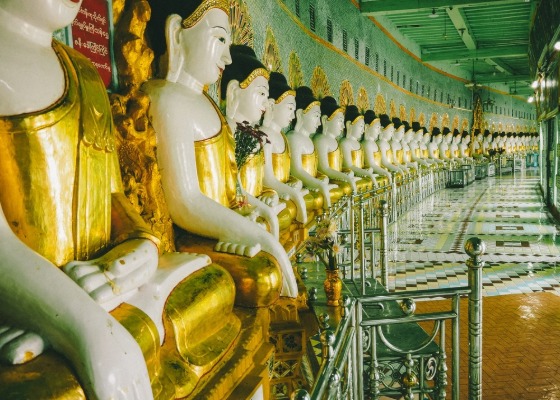
Burma boasts a rich artistic tradition, based mainly on Buddhism and the country’s diverse ethnic communities. Despite the ravages of the Second World War, when Burma suffered two invasions, and the later depredations of insurgent groups and criminal gangs, there were still many public monuments to traditional art when Ne Win seized power. The gold plates and precious stones found on Rangoon’s famous Shwedagon Pagoda were safe, but elsewhere there were numerous statues, carvings, paintings, lacquerware, silverware and other precious artworks that were vulnerable to thieves and smugglers.
After the 1962 coup, when Ne Win’s doctrinaire policies sent Burma into a downward economic spiral and cut it off from the rest of the world, a thriving black market developed. Indeed, one prominent economist has estimated that during the entire Ne Win era the black market constituted two thirds of all Burma’s domestic and external trade. Corruption was rife. At the same time, the central government struggled to exercise control over large swathes of the country around Burma’s borders, which were dominated by ethnic armed organisations and narcotics warlords.
This lack of law and order set the scene for the systematic looting of Burma’s precious cultural heritage.
Under Ne Win, the purchase and export of Burmese antiquities was illegal. Newcomers to Rangoon’s small foreign community were told by Old Burma Hands that, if they wanted to buy an antique Buddha, or something similar, they would be better off doing so in Bangkok, rather than in Rangoon or Mandalay. In the Thai capital, there were stores filled with Burmese artworks that had been smuggled over the border. Not being from Thailand, and thus not subject to strict Thai laws against cultural theft and abuse of the kingdom’s religion, such items could be sold openly to foreigners and shipped overseas.
This trade was pretty brisk, encouraging Burmese smugglers and Thai shopkeepers to maintain a lively traffic in stolen goods. It helped explain the fact that reputable museums in places like the US, UK, Germany, France and Australia acquired large collections of rare Burmese antiquities. High-end design magazines like Architectural Digest and Elle Décor occasionally featured photographs of sumptuous houses, with Burmese artwork prominent in the background. Gilded Buddha images, woven kalaga tapestries, red lacquer tables and kammavaca religious texts were considered fashionable focal points.
Burmese antiquities were also available in Burma itself. There were black market traders who, at a price, could find almost anything that was wanted. Under Ne Win, diplomats were able to fill their houses in Rangoon with Buddha images, traditional carvings and other objets d’art. After the 1988 uprising, and the relaxation of residency rules, foreign businessmen and even tourists joined in the free-for-all. They were somehow able to ship their acquisitions home at the end of their time in Burma, either for display or possible resale. One diplomat’s collection was later donated to a major American university.
Travelling up-country, particularly to the more remote parts of Burma, it was easy to see where such items had come from. Local pongyis (monks) complained that, against all traditional Burmese custom and practice, thieves often invaded pagodas and monasteries to steal pieces of value. Carved nats (animist spirits) were a favourite target, as they were small, portable and in demand from foreign collectors. Buddha statues that were too heavy to move had their heads and hands amputated. Such fragments still fetched high prices on the black market. Archaeological sites were ransacked for old ceramic wares.
While some of these stolen items found their way to Rangoon, facilitated by bribes and other payoffs, most of them were smuggled out of the country. Mule trains carrying opium and heroin, mainly through the Shan States, also carried art works for sale to Thai middlemen. Occasionally, larger items were loaded onto elephants (which were also trafficked). A visit to the antique shops along Silom Road and Suriwongse Road in Bangkok revealed the extent of this underground trade. More recently, smugglers have turned to social media platforms to line up direct sales in Thailand and further afield.
Myanmar is a signatory to the 1970 UNESCO Convention on the Means of Prohibiting and Preventing Illicit Import, Export and Transfer of Ownership of Cultural Property. However, the authorities seem unable or unwilling to enforce its provisions. As Robert Bociaga found a few years ago, the sale of antiquities continues, both in Rangoon and Bangkok. There are even websites advertising “beautiful and rare Burmese artifacts” for sale to wealthy collectors. Many of the genuinely old items listed on these sites seem to have been acquired in Thailand, suggesting that they were smuggled out of Myanmar.
Tragically, conflict, corruption, greed and poverty over the years have meant that Myanmar has been progressively stripped of valuable artifacts, while important cultural sites have been despoiled by vandals and thieves. Even now, with a civil war raging and almost two thirds of the country under the effective control of armed opposition groups, the trade in contraband continues apace. With the country in such turmoil, it is difficult to see a time when Myanmar’s national treasures might be better protected by the authorities, and those items smuggled out of the country returned to their rightful home.
Andrew Selth is an Adjunct Professor at the Griffith Asia Institute, Griffith University, in Brisbane, Australia. His latest book is “Myanmar: The Making of an Intelligence State” (Singapore: ISEAS Publishing, 2026)
How can we help? Get in touch to discuss how we can help you engage with Asia