Increasing ambitions: Australia keeps building momentum with ASEAN
Australia has been making positive moves in its engagement with ASEAN in recent times, writes Nicholas Farrelly. And despite the organisation’s flaws and doubts about how it would manage future crises, Australia has little choice other than to invest in its ASEAN diplomacy.
26 November 2025
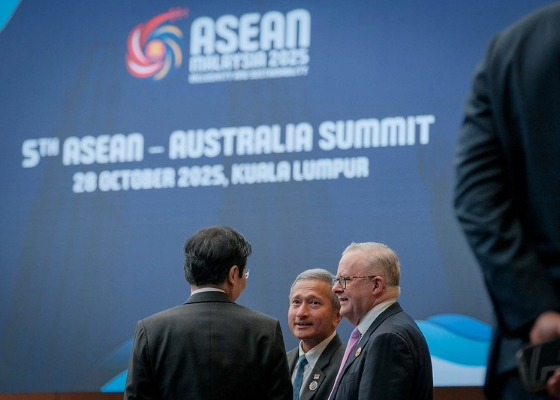
Late each year, leaders from around the world land briefly in a tropical Southeast Asian city for a spurt of summitry centred on the Association of Southeast Asian Nations (ASEAN). In 2025, it was Malaysia’s turn, the culmination of its year chairing ASEAN, a once-in-a-decade role stewarding regional diplomacy.
Prime Minister Anwar Ibrahim, after three years in charge of Malaysia’s government, welcomed leaders and officials from near and far, with a special focus on the elevation of Timor-Leste to full ASEAN member status, the first new member since the 1990s.
For Australia—as ASEAN’s first Dialogue Partner dating back to 1974 and its first Comprehensive Strategic Partner since 2021—the meetings in Kuala Lumpur were awarded serious diplomatic attention.
The muscling up of the Australian Mission to ASEAN over the past 15 years, and expansive mandate of the resident Ambassador, means that nowadays a very experienced diplomatic team based in Jakarta takes responsibility for advancing Australia’s interests in ASEAN forums.
Prime Minister Anthony Albanese and his senior ministers have developed their own ambitious approach to ASEAN, drawing heavily on the inter-generational project of more than 50 years of sustained Australian cooperation with Southeast Asia, bilaterally and in the still evolving multilateral architecture.
Yet across that half-century, there have been few moments where the tempo and ambition were ever so high, and when the Australian intent to develop further linkages was so clear. Building on the successes of the 2024 ASEAN-Australia Summit in Melbourne, the Albanese team is showing exactly the persistence and determination that successful diplomacy in Southeast Asia requires.
One example is the creation of the ASEAN-Australia Centre, which has received positive attention in its first year, with the Canberra-based Centre team rapidly advancing activities in many different spheres. It is, for instance, making large investments in the next generation of leaders working at the interface between Southeast Asia and Australia.
Whether it is specific events like the annual ASEAN Think Tank Summit, which Australia helps co-fund, or long-term cooperation on other topics like human trafficking, disaster response, digital economy, and trade policy, Australia is certainly a trusted and close partner for the region. There will always be calls that more can be done, yet the same voices regularly confirm the value of the often unheralded work occurring across the full scope of ASEAN-Australia engagement, particularly at the political and official levels.
International educational links, now strong across three full generations, remain an essential part of this story. It is common, at major policy and analytical events in the region, to find that a high proportion of those leading discussions are Southeast Asian graduates of Australian universities.
In these policy forums, the limitations of the ASEAN system are well-known and widely discussed. Still, insufficient attention is sometimes paid to the value of Southeast Asia’s patient, even ponderous, methods for regional engagement.
There have been serious tests in recent times, including re-ignited conflict between Cambodia and Thailand, and other hot issues like the civil war in Myanmar, push-and-shove with China in the South China Sea, and the unpredictable behaviour of the Trump White House.
ASEAN gives these topics attention, both in its formal agendas and in the countless other discussions that happen at the margins of major regional meetings. The lack of deep consensus that is often apparent, especially on fraught matters like better managing the Myanmar crisis, does not mean that nobody is trying to find a workable solution.
For Australia, the delicate weighting of statements of shared policy intent, in a context where there will remain areas of disagreement with individual ASEAN members, is an essential part of regional diplomacy. Under these conditions, Australia’s long-term interests are usually best advanced by continually finding the balance between the straight and the more elliptical, and the short- versus the very long-term.
For instance, the announcement in Kuala Lumpur of a significant investment from Monash University in its Malaysian campus is taken as an example of the direction that Australia wants to keep taking: Mutually supporting and reinforcing long-term partnerships, with an eye to multi-generational returns. Running an Australian university in Southeast Asia also means balancing many different stakeholder priorities, including those of Australian policymakers, students and academics.
Australian businesses, while often criticised for missing opportunities in Southeast Asia, are proactively engaging too, including through the recent “landing pads” in Singapore, Ho Chi Minh City and Jakarta for export-ready tech start-ups. The fact, though, that of the 11 ASEAN members only Singapore makes the list of Australia’s top 20 investment destinations is an obvious area of concern.
The potential for Australian superannuation funds to bolster such efforts is apparent, with Prime Minister Albanese discussing a $20 billion investment pipeline during his visit to Kuala Lumpur.
At the same time, the New Colombo Plan has been redesigned to support more immersive, long-term learning experiences for the next generation of Australians focused on Southeast Asia. Indonesia, Vietnam and Timor-Leste are now all top priorities for this decade-old program. There are high ambitions for much greater focus on Southeast Asian language skills; a theme that is also apparent in the ongoing parliamentary inquiry into Asia capability.
The fact that after the ASEAN meeting in Kuala Lumpur, the Australian Prime Minister then welcomed the Indonesian President, Prabowo Subianto, to Sydney to announce a joint security treaty is a further sign of the times. Australia is working with ASEAN members—collectively and individually, with the obvious exception of Myanmar—in ways that are beyond the historical norm.
And the clear-eyed assessment that—for all the contradictions of ASEAN diplomacy—there is immense value in Australia showing more commitment to the regional grouping is the right one. It reinforces Australia’s long-term capacity to engage diplomatically on Southeast Asian terms and, therefore, to strengthen regional economic and security infrastructure against external threats.
Whether it is handling the short-term consequences of erratic US trade policy or the potential for devastating war sparked by China’s aggressive military build-up against some of its neighbours, ASEAN has demonstrated its ability to keep everyone talking and thinking about more measured solutions.
While there will be ongoing criticisms and calls for fuller ASEAN reform, including in recent times from leading Thai and Indonesian analysts, the formal diplomatic infrastructure, and the varied cultures that sustain it, pushes ahead in its own laborious fashion. Australia has little choice but to welcome new ideas and innovations while also dealing, in the here-and-now, with the stilted nature of current practice.
In future crises, ASEAN may of course struggle to adjust quickly enough, imperilling its own legitimacy and sense of purpose. In the meantime, however, there are plenty of reasons for Australia to continue supporting ASEAN’s underpinning role and its evolving models of bilateral, regional and global diplomacy. While imperfect, those diplomatic models have proven superior, in Southeast Asia at least, to any available alternatives.
Professor Nicholas Farrelly is a Pro Vice-Chancellor at the University of Tasmania. He is also a member of the inaugural Advisory Board for the ASEAN-Australia Centre. These are his own views.
Image: "The 5th ASEAN-Australia Summit Highlights Deeper Cooperation" by ASEAN Secretariat
How can we help? Get in touch to discuss how we can help you engage with Asia