Behind Indonesia’s days of unrest
President Prabowo Subianto declared victory over street protests when he left Indonesia to attend pre-arranged meetings in China this week, but he left behind a country still prone to unrest from economic hardship and inequality, writes Yohanes Sulaiman.
4 September 2025
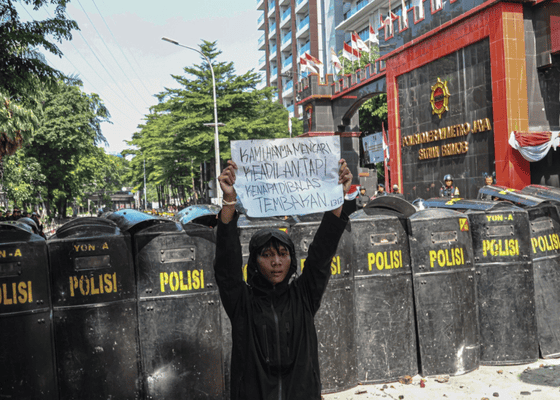
On August 29, Indonesia was hit by the biggest, most violent protest since the fall of Suharto in 1998. Anger over economic mismanagement, fuelled by the tone-deafness of government officials and parliamentarians, had already led students to rise up in protest in previous days. But when, on the night of August 28, a police tactical vehicle ran over and killed Affan Kurniawan, a motorcycle delivery driver who was in the wrong place at the wrong time, the outrage boiled over.
Mobs burned several regional legislative buildings and looted houses belonging to four of the most notorious and hated members of the national parliament, the People's Representative Council (DPR), and the official residence of the Minister of Finance Sri Mulyani Indrawati.
Not surprisingly, people drew parallels with the 1998 May riots. Starting in 1997, a deep economic crisis sparked months of campus protests that culminated in the shooting of four students at Jakarta’s Trisakti University on 12 May 1998. What followed was days of mass violence, vandalism, looting and the rape of Chinese women. It ended with the fall of Suharto on 21 May. While the parallel is striking, notably that Indonesia's economic growth is declining, unemployment is rising, and the government is short of money, there are several reasons why the current protests are very different from those of 1998 and will lead to a much different outcome this time, at least in the short term.
Death of Leadership
First and most importantly, the 2025 protests are characterised by their decentralisation; they are leaderless and lack a single strong hierarchy. Essentially, the protestors are a coalition of groups that coordinate their movements through social media.
As a result, unlike 1998, which could look to prominent opposition figures, notably the late Abdurrahman "Gus Dur" Wahid, Amien Rais, and Megawati Sukarnoputri, there is no clear leader to inspire the 2025 protest.
There are two implications of this phenomenon.
First, there is a question of the effectiveness of the protest. Lacking a clear leader means that the protests are much less sustainable as each constituent of the coalition has its own interests, goals, and other considerations. For example, on 28 August labour union protesters decided to end their protest at the parliament at 1 pm despite the fact students continued protesting until late at night. Several student organisations then ended up not joining the planned protest on 1 September, citing the fear that the protest was infiltrated by paid troublemakers. This, in turn, sapped the intensity of the protests and as a result it is questionable whether the movement is sustainable in the long run.
Second, and perhaps most importantly, students have shown they are skeptical of the political elite and political influencers, most likely a fallout of the so-called "Jokowi phenomenon," where people, sometimes blindly, put their faith in former president Joko "Jokowi" Widodo as the new Messiah. By 2024, Jokowi’s desire to extend his term and his political manoeuvring to ensure his underage son, Gibran Rakabuming Raka, was elected Vice President caused many to sour on him and refer to him by his childhood name "Mulyono" as a way to insult him. That the protest movement in recent years is decentralised—growing both laterally and underground—shows that these protesters most likely no longer trust anyone who claims to be their representative or understand the burden that the young generation faces. In addition, many popular influencers ended up obtaining plum positions in the Prabowo administration, their arrogant, out of touch behaviors, and the revelation that many are paid to promote the government's narrative online badly hurt their credibility.
Wars and Rumors of Wars
At the same time, the clear difference between the 1998 and 2025 protests is that there is no clear successor in waiting to Prabowo who would benefit from the chaos on the streets. While the 1998 protests were held against the backdrop of rivalry among political elites, representing distinct images or identities of political values, the battlelines this time are less clear.
As a result, rumours of unknown agents provocateur are rife, especially with the burning of legislative buildings and seemingly organised looting of houses belonging to parliamentarians and Sri Mulyani. Retired General Hendropriyono blamed foreign agents for the protests. Prabowo himself declared foreign henchmen were behind many protests and he singled out foreign “mafia”—an allusion, many believed, to oil trader Riza Chalid, who is wanted for corruption in Pertamina, the state-owned oil and gas company. Sputnik, a Russian media outlet infamous for peddling conspiracy theories, joined the fray by claiming George Soros was behind the protest.
Some Indonesian analysts, however, turned the focus of the blame game closer to home, citing infighting within the police force. Meanwhile, the police arrested some military personnel, with some police officers accusing the military intelligence unit (BAIS) of provoking the protests to delegitimate the police force.
There is also an accusation that former president Jokowi was behind the protest. And there are indications that Prabowo himself may believe this, considering the fact that during his live televised speech on August 31he was flanked by leaders or representatives from every political party, including the opposition Indonesian Democratic Party Struggle (PDIP). Strikingly absent was both Vice President Gibran Rakabuming Raka and a representative from the Indonesian Solidarity Party (PSI), led by Kaesang Pangarep, the other of Jokowi's sons. Later it was reported that Kaesang was sick. Furthermore, in face-conscious Javanese society, the lack of open consultation on perhaps the biggest crisis in Prabowo's presidency speaks volumes. The absence is especially noteworthy considering Prabowo has often openly consulted Jokowi on many issues with the press in tow.
What Next?
On September 2, Prabowo felt confident enough that the situation was under control that he flew to Beijing as earlier planned to attend China's military parade, marking an anniversary of the end of World War II. Effectively, Prabowo had declared his victory against the protest.
While he seems to have emerged stronger, there are warning signs ahead. Already there are complaints that Prabowo's concessions to the protesters, notably that the suspension of parliamentarians whose thoughtless actions and speeches incited the protest in the first place, were simple slaps on the wrist, as the MPs will still receive lucrative salary and benefits. It is doubtful the protesters are satisfied they have been heard, despite the President's declaration that he was asking the parliament to listen to people's aspirations. They will have noted that he visited injured policemen before his visit to Beijing, despite the declaration from Anis Hidayah, the head of the Indonesian Human Rights Commission, that a majority of casualties during the protest were the result of police brutality.
Essentially, without a drastic course correction, notably by truly listening to student demands and seriously tackling widespread community grievances over inequality and the state of the economy, Prabowo in the long term may see a much stronger backlash.
Yohanes Sulaiman is an Associate Professor in International Relations at Universitas Jenderal Achmad Yani, Cimahi, Indonesia.
Image: Wulandari Wulandari / Shutterstock.com