2024 Federal Budget: Implications for Asia trade and investment
Asialink Business analyst Robert Law assesses the implications of the 2024-25 Federal Budget for Australia’s trade and investment with Asia.
16 May 2024
Future made in Australia, with foreign capital
The 2024 Federal Budget is another building block in Australia’s efforts to position itself as central to the net zero transition, particularly around critical minerals and renewable energy supply chains.
The 10-year $22.7 billion Future Made in Australia package aims to drive the decarbonisation of the economy. The government won’t be able to realise its ambitions without foreign investment. However, FDI inflows have plateaued in recent years. Investment is being lured offshore to the US and Chinese investment in this sector is largely off the table.
The initiative aims to address this by establishing a National Interest Framework that will guide decision-making on significant public investments based on two ‘streams’: net zero transformation, and economic security and resilience.
The framework identifies five key sectors: renewable hydrogen, critical minerals processing, green metals, low carbon liquid fuels, and clean energy manufacturing, including battery and solar panel supply chains. It follows the recently announced changes to streamline the foreign investment regime for lower risk foreign investment proposals.
The Government has recognised that international investment will be crucial, with $68 million over four years for investment attraction, including $4.5 million for DFAT to woo international investors.
Renewable energy and critical minerals
Hydrogen will become an increasingly important part of Asia’s energy mix in coming decades, particular for partners such as Japan and Korea. However, the global hydrogen industry is still in its infancy. So, the budget includes a $8 billion production tax incentive to hopefully spur its growth.
On critical minerals, Australia is seeking to move down the value chain through a $7 billion Critical Minerals Production Tax to support refining and processing of 31 critical minerals.
Australia is increasingly competing with Indonesia in this space. Indonesia’s push into downstream refining of nickel led to the glut in global supply and the closure of several mines in Australia. As a result, nickel was recently included in this list of critical minerals.
Australian nickel miners have also sought to counter the supply glut by differentiating between their higher quality nickel and Indonesian nickel, which relies on acid leaching processes. However, the London Metals Exchange rejected a push earlier this year to recognise the different types of nickel.
The government will now develop its own scheme with $32 million for a Guarantee of Origin for renewable hydrogen, green metals and low carbon liquid fuels. It’s backing this up with $14.3 million to help develop global rules on ‘unfair trade practices’ and to negotiate benchmarks for trade in high quality critical minerals.
Key Asian markets
When it comes to Asian markets, Southeast Asia and India remain the priorities although China is back on the radar for exports.
Southeast Asia
The Government has provided $505 million for initiatives to implement the Southeast Asia Economic Strategy that were announced at the 2024 ASEAN-Australia Special Summit in March. Key initiatives include the establishment of the ASEAN-Australia Centre and landing pads for start-ups in Jakarta and Ho Chi Minh City, which this author called for previously.
Beyond the initiatives that have already been announced, there are still a number of recommendations from the Southeast Asia Economic Strategy that have not been taken up. Greater clarity from the government on the status of these recommendations would give business confidence that it remains committed to full implementation of the strategy.
India
The government will allocate $14.4 million to continue the successful Australia-India Business Exchange program to grow trade and investment. Interestingly, the government has not budgeted for its Maitri Scholarships beyond 2025-26, though it may address this in a future budget.
China
There are modest initiatives relating to China, including $8 million to support Chinese tourists travelling to Australia in groups. There is also $2 million to support agricultural exporters re-establish commercial connections in China. However, the initiative is also intended to support continued diversification into other markets, suggesting the government sees limitations on the trading relationship.
Modest trade initiatives
The government has provided modest further support to grow exports. Austrade will benefit from an additional $10.9 million to improve the Go Global Toolkit. This digital platform provides advice to companies considering exporting and has been steadily gaining traction since its launch.
Funding for the Export Market Development Grants has been extended out over the forward estimates to 2027-28, reflecting the government’s efforts to reform the scheme. It also provided continued funding for the Simplified Trade System.
A complex global context poses challenges
The government faces a complex and competitive global environment in which to deliver its Future Made in Australia agenda. Competition for capital is intense and Australia can’t match the scale of incentives that the US has offered through the Inflation Reduction Act. Key partners such as Japan and Korea think differently about the net zero transition, particularly when it comes to hydrogen. And Australia is increasingly competing with Indonesia on critical minerals, particularly with our push to differentiate between ‘green’ and ‘dirty’ nickel.
Ultimately, the government needs to rely on business to act on the incentives it has put in place and hope the result will position Australia competitively in the future global economy.
Robert Law is Director, Advisory & Insights, at Asialink Business.
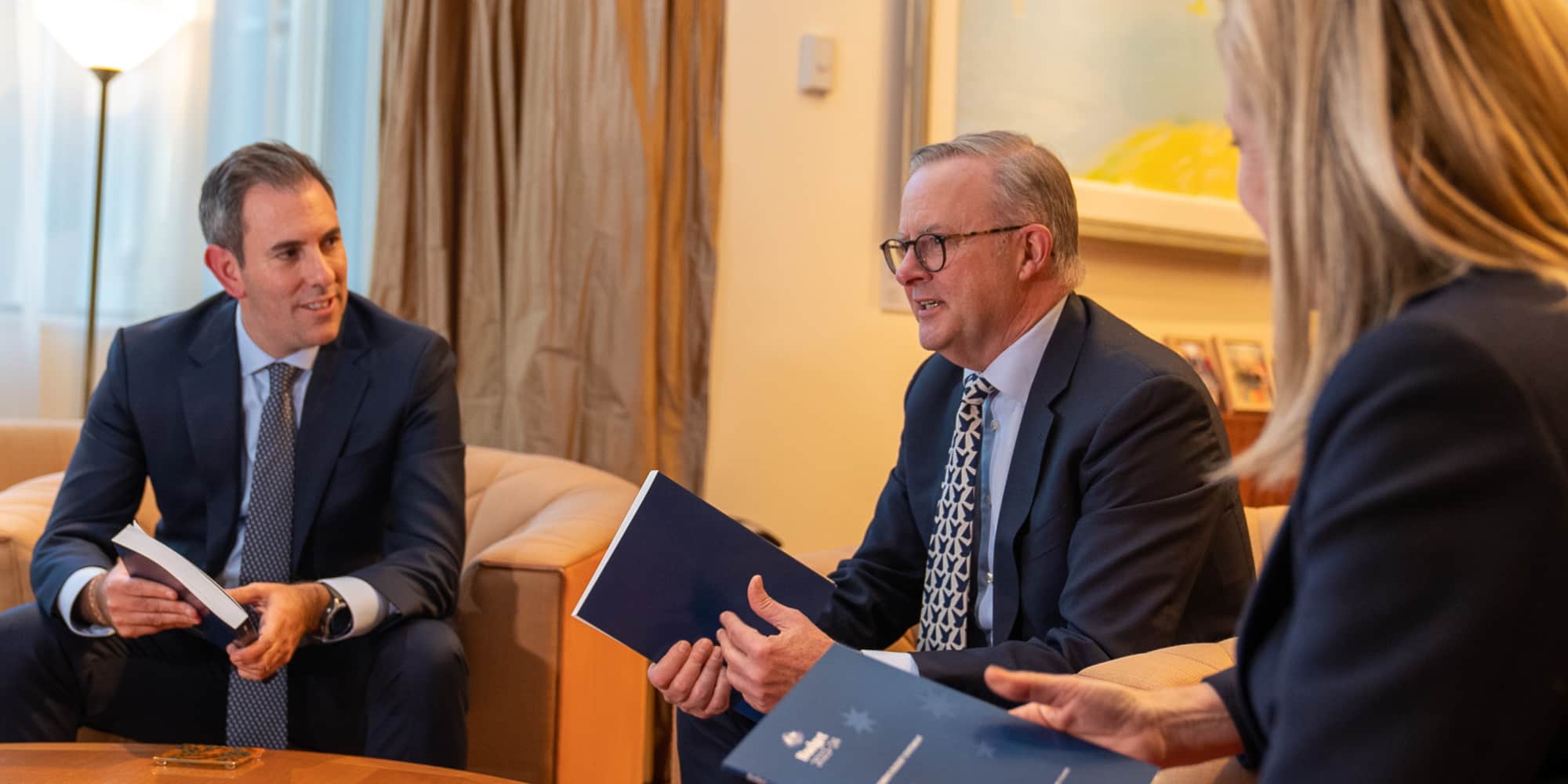
Image: Jim Chalmers MP's Twitter (@JEChalmers) posted on 14 May 2024.
How can we help? Get in touch to discuss how we can help you engage with Asia